



Pink Iguana
The Rare Reptile of Wolf Volcano, Galapagos
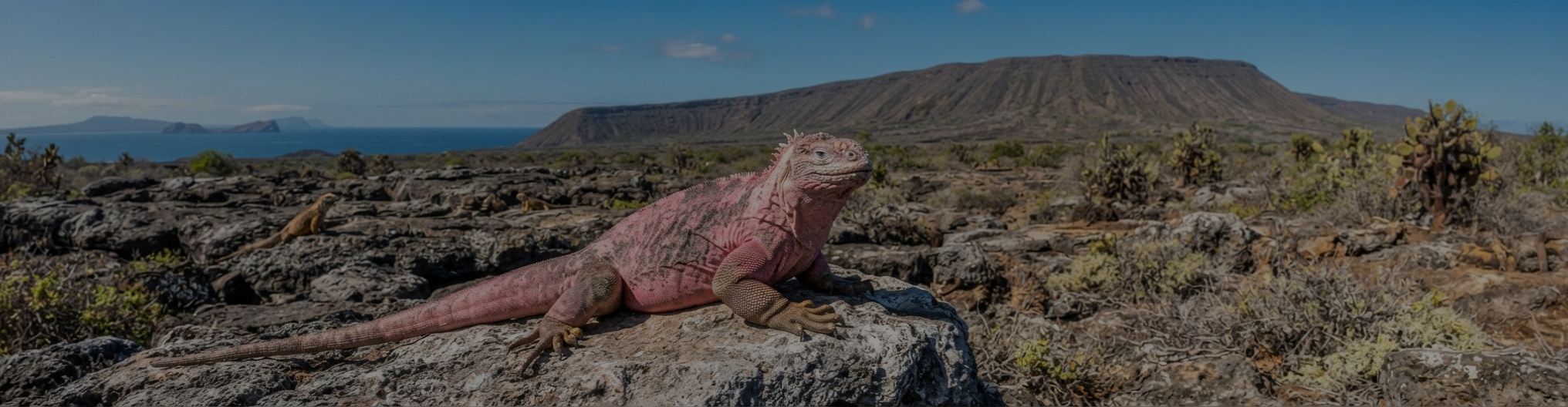
The pink iguana is one of the rarest and most remarkable reptiles on Earth. Scientists know it as Conolophus marthae, or the Galapagos pink land iguana. It lives in one remote corner of the Galapagos Islands, on the northern slopes of Wolf Volcano on Isabela Island.
Unlike the green or grayish reptiles we usually imagine, this animal stands out with pinkish skin and dark markings. Its unusual color, tiny habitat, and small population have made it a priority for researchers and conservationists.
What Makes the Pink Iguana Unique?
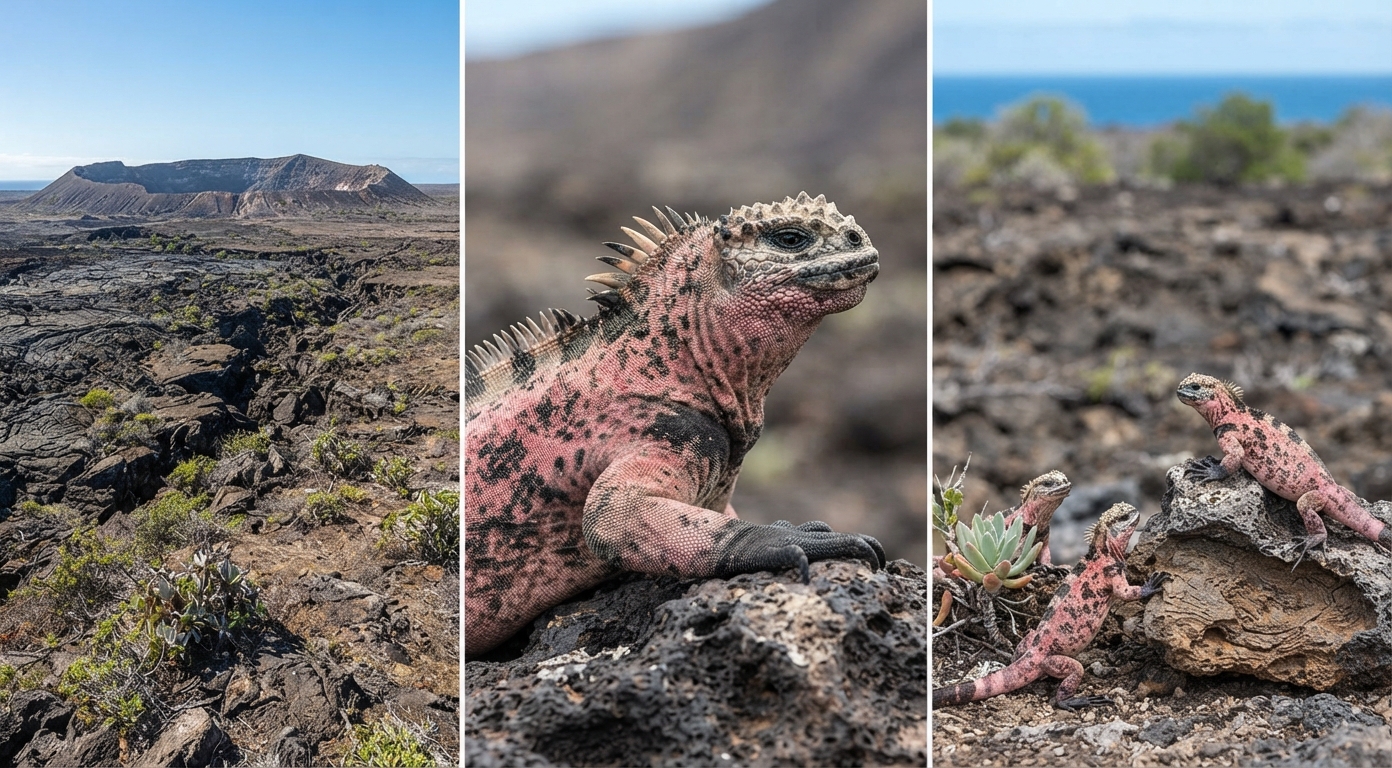
The pink iguana is not simply an iguana with a different skin color. Instead, it is a distinct species with its own evolutionary history. Its pink tones appear most clearly around the head, neck, and sides, and dark stripes cross parts of its body.
The intensity of the color varies from individual to individual, ranging from intense pink to paler shades. Scientists still do not fully understand why. Therefore, researchers avoid assuming that the color developed for camouflage or temperature control without enough evidence.
A Sturdy Body Built for Volcanic Terrain
Despite its delicate look, this iguana is a tough survivor. It has a robust, muscular body, four strong legs, clawed toes, and a long tail. The claws grip rough ground, while the tail helps with balance and can serve as a defense.
Its small, alert eyes and strong jaw suit a plant-based diet. Additionally, small scales protect its skin from the environment. As a wild species with specialized needs, it requires no human care.
Where Does the Pink Iguana Live?
The pink iguana has one of the most restricted ranges of any reptile. It is endemic to the Galapagos, so it occurs naturally nowhere else on Earth. Researchers know only one wild population, on the northern slopes of Wolf Volcano.
The habitat consists of volcanic slopes, rocky ground, dry vegetation, and shrubland. Freshwater is limited, and food can become scarce. Even so, the iguana has adapted to these conditions over many generations.
However, Wolf Volcano is active, which adds another challenge. Eruptions can change the landscape, damage vegetation, and affect an already small population. Furthermore, the isolated location makes the species hard to study. Only authorized park rangers and scientists can work there, and they must do so without disturbing the fragile environment.
What Does the Pink Iguana Eat?
The pink iguana is mainly herbivorous. Its likely food includes prickly pear cactus pads, flowers, and fruits, similar to other Galápagos land iguanas. These plants provide both nutrients and moisture, which matters in a dry environment.
When iguanas eat fruit, they may also help disperse seeds. Nevertheless, researchers are still investigating its exact diet and ecological role, so some details remain uncertain.
Pink Iguana Behavior and Reproduction
Pink iguanas live on land and are ectothermic, so sunlight and surrounding temperatures shape their activity. They also communicate through body movements. In particular, they use a distinctive head-bobbing pattern that differs from other Galápagos land iguanas.
Like other reptiles, they reproduce sexually, and females lay eggs in suitable nesting spots. Eggs and hatchlings face serious risks from introduced rats and feral cats. Adults can also fall prey to native Galápagos hawks.
Still, there is encouraging news. Scientists report more hatchlings, which hatch green and gradually turn pink as they grow. In April 2025, a scientific expedition led by the Galapagos National Park Directorate recorded six individuals not previously documented among the 68 iguanas monitored. The team also recorded one juvenile.
Discovery and Evolutionary History
Galapagos National Park rangers first observed this iguana in 1986. At first, its unusual look did not lead to recognition as a separate species. After genetic analysis and physical studies, scientists formally described it in 2009.
One published analysis suggests its lineage split from other land iguanas about 5.7 million years ago. As a result, the pink iguana represents an ancient branch of the Galápagos reptile family tree. Moreover, it shows that two reptiles can look similar while having very different genetic histories.
Is the Pink Iguana Endangered?
Yes. The IUCN Red List classifies the pink iguana as Critically Endangered, the highest threat category before extinction in the wild.
The exact population is hard to establish. An IUCN assessment estimated about 300 individuals, with a range of roughly 270 to 372. Other organizations report around 200 or fewer adults. These figures differ because they use different methods and age groups, so none is a precise live count.
Several threats put the species at risk:
- Volcanic eruptions: the whole known population lives on an active volcano.
- Drought: reduced rainfall limits plants, food, and moisture.
- Introduced predators: feral cats and invasive rats threaten eggs and young.
- Small population size: random events and disease can hit harder.
- Genetic vulnerability: limited diversity raises inbreeding risks and reduces adaptability.
A widespread species can survive a local disaster because other populations live elsewhere. The pink iguana has no such safety net. Protecting this single habitat is therefore essential.
How Scientists Protect the Pink Iguana
The species receives protection within the Galapagos National Park. In addition, an IUCN-supported management plan for 2022 to 2027 aims to improve knowledge of its biology, manage threats, and support its long-term survival.
Conservation work includes monitoring individuals, studying their movements, and controlling invasive species. In 2025, a field expedition used GPS and telemetry devices on selected iguanas. Researchers also installed camera traps and collected samples from iguanas and plants to study their feeding ecology.
Visits to the area are restricted to authorized park personnel and researchers. This measure is important, since protecting a rare animal sometimes means limiting chances to see it in person.
Why the Pink Iguana Matters for Biodiversity
The pink iguana is valuable for more than its looks. It represents a unique part of Ecuador’s natural heritage, with its own genetic information and adaptations. When a species disappears, that evolutionary history is lost forever.
It also shows why conservation must protect habitats, not only individual animals. The iguana depends on its food plants, nesting conditions, volcanic environment, and the control of invasive predators. Finally, it reminds us that small, little-known species can face risks as serious as famous, charismatic ones.
A Rare Reptile Worth Protecting
The pink iguana (Conolophus marthae) combines pink skin, ancient ancestry, and an extremely limited home on Wolf Volcano. Conservationists work hard to protect it through monitoring, invasive-species management, and habitat protection. Even so, many questions about its biology remain unanswered, and continued research will be essential.
Protecting it means preserving more than a rare reptile. It means safeguarding a remarkable piece of Galapagos evolutionary history.